-
Tel : 86+19526646869
-
Email : admin@gmarkcn.com
-
Skype : +86-17803901720,86+13100396144


Tel : 86+19526646869
Email : admin@gmarkcn.com
Skype : +86-17803901720,86+13100396144
Learn how to choose 0.5mm, 1.0mm, 2.0mm, or 3.0mm acrylic foam tape for different bonding, gap-filling, and mounting applications.
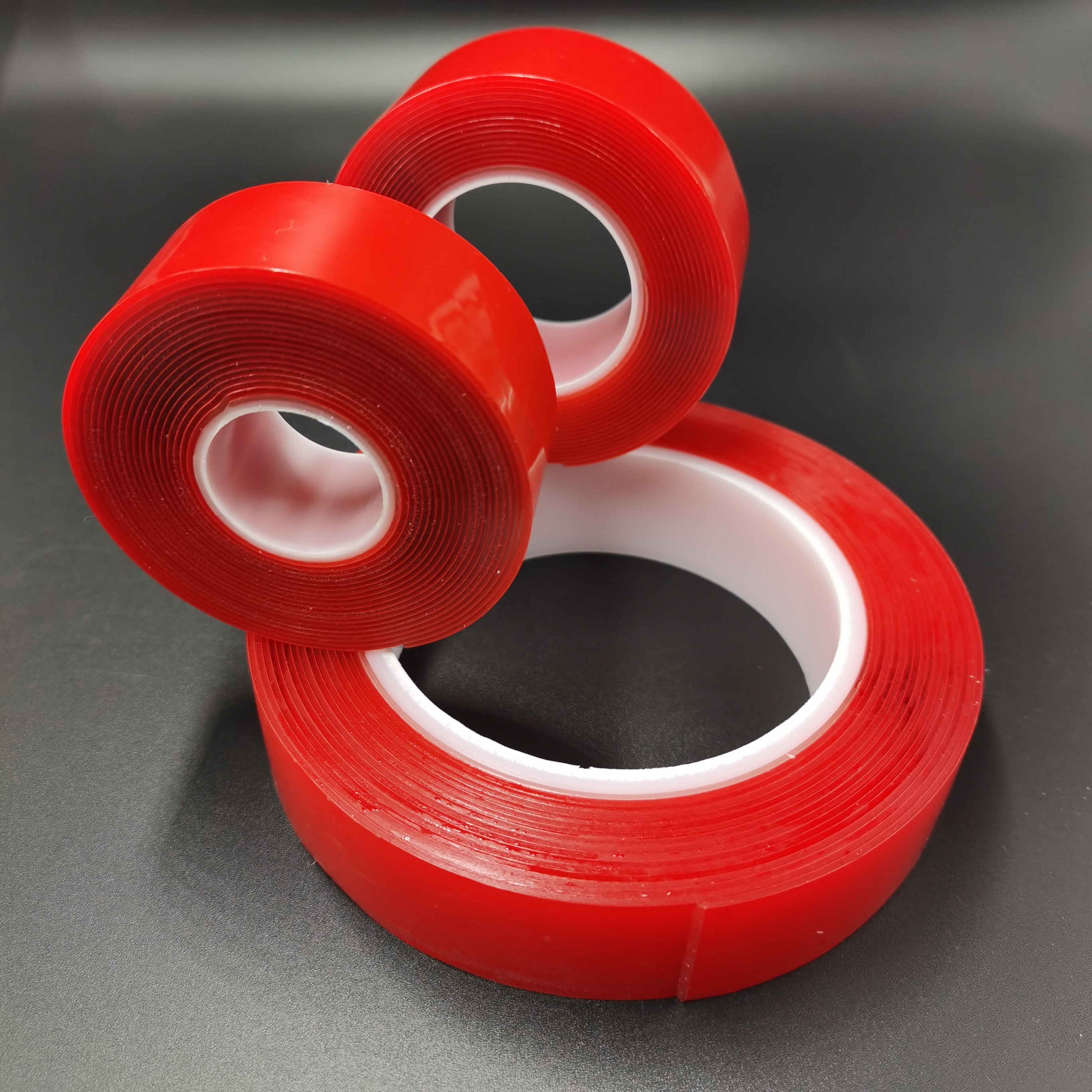
Acrylic foam tape is widely used as an alternative to mechanical fasteners, liquid adhesives, and traditional mounting methods. It provides strong adhesion, flexibility, vibration resistance, and excellent conformability to different surfaces.
However, choosing the right thickness is just as important as choosing the adhesive type. Acrylic foam tapes with different thicknesses can perform very differently when dealing with uneven surfaces, gaps, stress, and environmental conditions.
Common thicknesses include 0.5mm, 1.0mm, 2.0mm, and 3.0mm. So, how do you know which one is right for your application?
In this guide, we will explain the main differences and recommended applications for each thickness.
Not necessarily. The thickness of acrylic foam tape does not directly determine its adhesive strength. Adhesive formulation, substrate, surface energy, temperature, contact area, and application pressure all affect bonding performance.
However, thickness does influence the tape's ability to absorb stress, compensate for surface irregularities, and fill gaps. For example, a thin 0.5mm tape may be ideal for smooth, flat surfaces, while a 2.0mm or 3.0mm tape can better accommodate uneven surfaces or larger gaps.
A thicker acrylic foam tape generally provides:
This makes thicker tapes particularly useful when two substrates are not perfectly flat or when the joint is exposed to vibration or movement.
0.5mm acrylic foam tape is a good choice when you need a relatively thin bonding solution while maintaining strong adhesion.
It is commonly used for:
Because of its low profile, 0.5mm tape can provide a cleaner appearance and reduce the visible thickness of the bonding layer.
It can handle minor surface irregularities, but it is generally better suited to smooth and relatively flat substrates. If the surfaces have noticeable gaps, curves, textures, or dimensional tolerances, a thicker tape may provide better contact and stress distribution.
1.0mm acrylic foam tape is one of the most versatile thicknesses because it provides a balance between low profile, conformability, and bonding performance.
Typical applications include:
Compared with 0.5mm tape, 1.0mm tape provides additional thickness for absorbing stress and compensating for minor surface irregularities.
If your application involves slightly uneven surfaces or moderate vibration, 1.0mm may provide a more reliable bonding layer. It is also a good starting point when the exact tape thickness has not yet been determined.
2.0mm acrylic foam tape is designed for applications where greater conformability and gap-filling capability are required.
Common applications include:
The additional foam thickness helps the tape adapt to surface irregularities and distribute stress across the bonded area.
3.0mm acrylic foam tape is generally selected when the application requires maximum gap compensation and flexibility among these four options.
It can be considered for:
However, thicker does not automatically mean better. If the substrates are smooth and the application requires a low-profile appearance, 3.0mm may be unnecessary.
A simple way to compare the four thicknesses is:
| Thickness | Main Advantage | Typical Applications |
|---|---|---|
| 0.5mm | Thin, low-profile bonding | Labels, nameplates, electronics, smooth surfaces |
| 1.0mm | Balanced performance | Automotive trim, signage, industrial assembly |
| 2.0mm | Better conformability & gap filling | Panels, exterior trim, uneven surfaces |
| 3.0mm | Maximum gap compensation | Large panels, heavy-duty mounting, construction |
The right thickness should be selected according to surface condition, gap size, substrate material, load, vibration, temperature, and required appearance.
No. Before selecting an acrylic foam tape, you should also consider:
Yes. At GMARK, we can provide different acrylic foam tape constructions and thickness options for industrial bonding and mounting applications. If you are unsure whether 0.5mm, 1.0mm, 2.0mm, or 3.0mm is suitable for your project, you can provide us with your:
Our team can recommend a suitable acrylic foam tape based on your actual application.


Tel: +86 13100396144 | Contact: Mrs Diana Zhou
E-mail: sales9@gmarktape.com
Contact me for more details and to get a free sample.
Email : admin@gmarkcn.com
Skype : +86-17803901720,86+13100396144
No.7 Liyuan Road, Xuzhen Zone, Zhangmutou Town, Dongguan City, Guangdong, China